
Alice was designed to solve a deceptively simple problem: helping customers reserve a piece of clothing over the phone. But behind that simplicity was a surprisingly nuanced design challenge.
The brand Alice represents is well-loved across a wide and diverse Australian customer base - spanning generations and varying levels of comfort with automated phone systems. That meant Alice needed to feel approachable and unhurried, never robotic. Built on an intent-based model, Alice can check real-time stock across store locations - searching by item, size, and colourway - and complete a reservation on the customer’s behalf, ready for pickup.
The Challenge:
Location was consistently the hardest entity to capture reliably. Many Australian suburb names derive from Indigenous Australian languages, with phonetic patterns the speech recognition engine hadn’t been well trained on - and with no generative model available to interpret ambiguity, every mismatch between what a customer said and what the system expected had to be handled through deliberate design rather than inference.
Alice
The Solution
The solution combined phonetic matching to catch near-misses with a structured escalation path: asking the customer to repeat the suburb name, prompting them to spell it out letter by letter if needed, confirming back what was captured, and handing over to a human agent if there was still no confident match. Each step gave the system another chance to recover before defaulting to a person, rather than guessing or leaving the customer stuck in a loop.
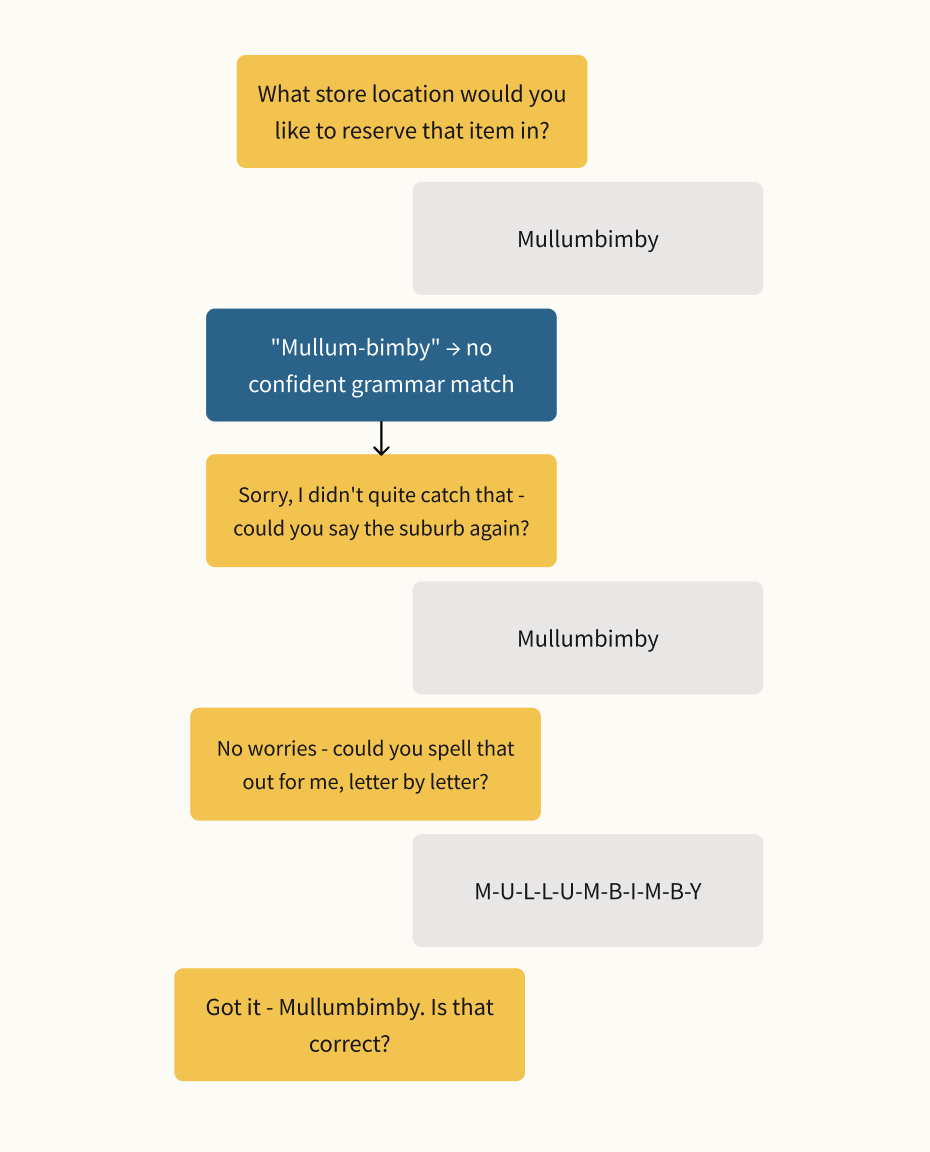
Example of the recovery path in motion.
Impact
The result was a voice experience that felt genuinely effortless - one that could serve a first-time caller just as comfortably as a loyal customer who’d been shopping with the brand for decades.